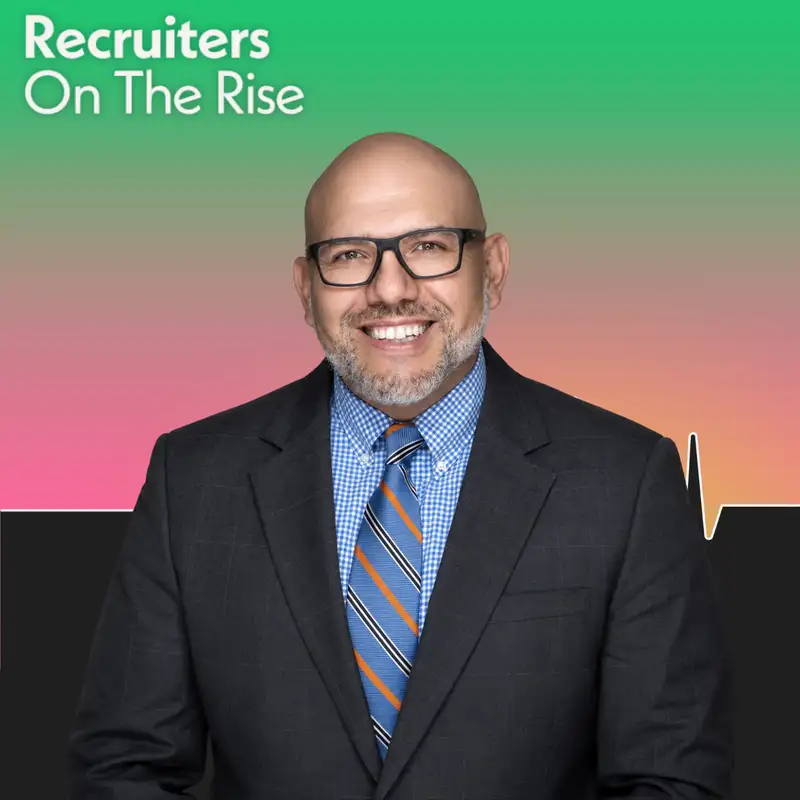
ROTR - Pedro Velis
[00:00:00] This is Recruiters on the Rise, and I'm Colleen Gallagher. Join me for candid conversations with talent leaders as we explore the work that drives them, the lessons they've learned, and how they're helping people find careers they love. This show is sponsored by Lavalier, an interview intelligence platform built by Textio.
Colleen Gallagher: Hello, everybody, and welcome to another exciting episode of Recruiters on the Rise. I'm so excited to have our guest today. He has over 20 years of experience building talent and HR function in industries, um, a lot of recruiters may never touch. Um, he spent six years as a staff accountant at Wawa before pivoting into recruiting, and we'll learn a little bit more about, about that transition.
He's also a self-described meme enthusiast who believes you can't survive in HR without a sense of humor. Um, and he quotes Christmas Vacation in team meetings to prove it. in his current role, he's taken on, um, a, a really big talent challenge, um, working at a [00:01:00] shipyard in Philadelphia that was just recently featured on 60 Minutes.
And, uh, we'll talk a little bit about, um, the growth and, and everything going on there and some of the challenges, uh, related to that, building out that workforce and trying to increase volume there. So he's currently the director of talent acquisition and workforce development at Hanwha, uh, Philly Shipyard.
Pedro Velez, welcome to the show.
Pedro Velis: Thank you. Thank you for that nice introduction
Colleen Gallagher: Yeah, I'm so excited to have you here. Um, all right. So the first question I like to ask my guests, um, what's the one thing or one action that sets the best recruiters apart from the rest?
Pedro Velis: Great question. That's a that's a good starter. I, um, I th- I've always believed that you, um, as a-- any talent acquisition professional, you have to, you have to learn your business. Like what we do, how do we do, how do we make money? How do we... So in this, in this case, how do we build ships? And all the critical processes in that and all the-- because that allows you to understand [00:02:00] all the key components, all the key jobs that are in there. Uh, and so building the relationships with your leaders to help you understand that business, or in that case, that business. Um, and so whether that's in operations, whether that's in maintenance or supply chain or finance, understanding how their jobs impact the, the, the bigger picture. Um, and then how do we make money, right?
I mean, that's what it comes down to. And so I think that was kind of put into my, my head early in my,
Colleen Gallagher: Yeah
Pedro Velis: the career is like, you know, you can go recruit for a job, but if you don't fundamentally understand what that job is or what, how that function works and operates, and operates within the other departments, you're just gonna fill a seat, and that seat turn over, and, uh, you're not gonna make the ki- the type of impact, um, for the organization
Colleen Gallagher: Yeah.
Yeah, it's so important I think, um
you know, I, I guess I often see it as like you have a recruiter who's coming in as the subject matter expert on hiring, but you have a hiring manager who's a subject [00:03:00] matter expert in the function and what they're doing. And so I think if, you know, you can have a conversation or find the way to bring the best of those things together, and often it's learning a little bit more, um, with some depth around, you know, what's really gonna resonate with the hiring manager, and I think getting to know the business and the economics and sort of the drivers behind it, um, are really important.
And so I, I'm, I'm curious, like when you think about, um, coaching recruiters or hiring, um, recruiters onto your team, like how do you assess for something like that?
Pedro Velis: so I, you know, I think my overall philosophy around just talent within the talent acquisition space, I try to have a diverse group of talent. I don't want people that look, feel, have my same background, right? We all have... So look for, at the end of the day is, um, your, your smarts, your brain, right? I, I'm looking for talent in that sense, right? [00:04:00] like I'll give you an example. I hired a young lady last year who, uh, started her career as an elementary education st- um, right, uh, teacher, and she a couple years and then decided that wasn't for me, right? And so she pivoted and took her career and decided to get an online, her online master's in HR. Had never recruited, but I knew going in that she had a capacity to learn. also looked at the job knowing that what the majority of the work she was gonna be doing was working with schools and technical trade students, right? so making those connect, that connection to say, "You kind of know the education side.
You know what
Colleen Gallagher: Yeah
Pedro Velis: students are like. can teach you recruiting." You know, recruiting, um, at the end of the day, it's, it's a people business. It's a soft skill business.
Colleen Gallagher: Yeah
Pedro Velis: Um, it's under... Right? And making those connections. And so I, I, I find that sometimes finding maybe that non-traditional person [00:05:00] sometimes your best recruiter. Um, I have another gent- another gentleman on my team who, again, I was not able to hire because he's been with the shipyard for 25 years, and he started his career as a carpenter and became a shipbuilder, became a supervisor, and worked in health and safety, and about three years ago became a recruiter. what he brings is the technical ex-
Colleen Gallagher: Yeah
Pedro Velis: right? He's teaching me
Colleen Gallagher: Yeah.
Pedro Velis: We build ships,
Colleen Gallagher: Yeah
Pedro Velis: right? Which is what I value. And so when you surround yourself with people that bring you a little bit of a different expertise, that's what makes, I think, a, a talented team.
Colleen Gallagher: Yeah. Um, I guess transitioning a little bit more to, you know, the, the industry that you're in right now. Um, I, I think you said 75% of your workforce is skilled trade, so that would include like welders, pipe fitters, you know, the people who are physically building the ships. Like how is recruiting for those roles different versus, um, you know, some of the more traditional roles [00:06:00] that people think about, uh, you know, recruiting technology, product, sales?
Pedro Velis: So the, the, the scary part that we face today is that there is a massive shortage of welding talent where it's just shipbuilding trade talent. Um, there is a, I think the Department Defen- Defense slash War is estimating that there is about 175,000 skilled worker shortage that's coming in the next ten years.
We just don't have enough skilled workers build ships. So you start with that, um, and you start with that to, you know, welders, when I think about welders, they-- it, it's about time under the hood and practice. So there are great schools out there, um, that teach folks
Colleen Gallagher: Yeah
Pedro Velis: but they still need the hands-on learning and the training and, and then so what's the...
You know, you have this delicate balance between [00:07:00] production and honing your craft. you know, one thing I've learned is, at least in our area, and I think this is across, um, the, you know, I think the US, right, there is a, there's a lot of un-um, unoccupied welding booths, and that's just a lost opportunity. There-- While there has been an increase over the last few years of more folks going into skilled trades, the, quite frankly, we, we need a, a, a, a bigger push. Um, and I think that starts earlier, whether that's at the middle school or even at the high school,
Colleen Gallagher: Yeah
Pedro Velis: get more folks to understand that a trade job isn't this dirty job or isn't this, you know, uh, you know, uh, an afterthought of a career, but it's actually a career that can give you only very viable wages, but it can launch you into other careers.
And again, I go back to my recruiter. He started like that. That was his trade, and he's evolved [00:08:00] over time. I-- what worries me more than anything else is how do I go out and find this talent and get them skilled up
Colleen Gallagher: Yeah
Pedro Velis: in a shipyard that still has to produce, um, and we still have to meet our production numbers.
Um, and in the shipbuilding world, it's just practice, practice, practice, and it takes hours and hours and hours of it.
Colleen Gallagher: Yeah. And so this is pr- uh, you know, this I think speaks to your, your workforce development sort of part of your role. And I think it was talked about in, um, the 60 Minutes story. Um, for those who haven't read it, I think it talks a little bit about... Or, or watched it. Um, you know, Hanwha obviously is a global company and also builds chips in other parts of the world.
And so there are other parts of the world where there are pretty robust training programs where you can scale, you know, you can put people into those training programs, and I think it has a much higher volume capacity. Um, so how are you thinking about building that out? Um, [00:09:00] you know, is that a partnering with a, with a trade, um, institution or, or a school, or are you all looking at developing that more robustly in-house?
Pedro Velis: So I, so I think there's a, it's a, it's a multi-pronged
Colleen Gallagher: Yeah.
Pedro Velis: Uh, or a mul-multi-channel
Colleen Gallagher: Yeah.
Pedro Velis: We do have a, a, a, an apprenticeship program. Um, it's a three-year program, and currently we h- we are able to produce about a hundred, 120 apprentices a year. We are investing, um, as a company to build a brand new training academy, which will allow us to increase that like I said, about a hundred to three hundred to potentially five hundred apprentices.
So that's one pipeline that we're looking at. But we-- that, that, that's only one solution. Um, and I-- and what we're looking at is other solutions, which is, to your point, we ha- we are starting to partner with trade schools and tech schools. I think that has, quite [00:10:00] frankly, become my number one job responsibility, um, in making the connections.
And, um, there's a school here locally in Philadelphia that has-- is willing to take on our curriculum, our training curriculum, and teach that curriculum at their school to help produce the welding talent we need. You know, I am speaking with other organizations who have welding booths, um, uh, Steam Fitters 420 here in Philadelphia.
They have an apprentice program, but they're, they have welding booths that sit idle. And so trying to connect them with another workforce development partner that could potentially have, um, folks interested in welding, getting grant funding and getting, making these connections between the, the ecosystem, um, where everybody, um, is making the, you know, the-- I think this has the same goal, which is to increase just the skills talent.
Um, that, that becomes my number one goal. I, you know, while I [00:11:00] wanna hire just for myself, reality is I have, we have to as a, as at least a Philadelphia region and maybe, you know, as, obviously as a country, we have to together to find those opportunities between partners,
Colleen Gallagher: Yeah.
Pedro Velis: schools,
Colleen Gallagher: Yeah.
Pedro Velis: And help develop that
Colleen Gallagher: Yeah. Yeah. Yeah, and I, you know, I think right now when there is a lot of fear around, like, what AI is going to do to some more, um, you know, traditional tech, tech roles or finance or things like that, it's, you know, good to know because I think your point is, is totally accurate. Like, I remember going through high school, right?
And I- you didn't hear a lot about the, these types of opportunities, but they can be very, um Um, lucrative might not be the right word, but like, it, it does have a higher level of wage wage than I think people understand.
Pedro Velis: Yeah. I mean, I, I will brag a little bit about our apprenticeship program. [00:12:00] It's a three-year program. We-- When you graduate it, graduate from it, you have 22 college credits, right? So you're close to an associate's degree, you're making somewhere between 35 to 40 bucks an hour. now you're looking at $80,000 without overtime, which we all know in manufacturing there's typically some sort
Colleen Gallagher: Yeah.
Pedro Velis: So you could be making six figures. Uh, again, if you're a high school student, and that's where you start your career, and now you're 21, you know, you're, you don't have-- you're not burdened with any college debt. Um, and I think that's, that's part of the selling point. But I, I, I think what people don't realize is, like electricians and welders, they command a high d-dollar, you know.
There, there are, there are traveling welders and pipe fitters and electricians who are making, you know, 75 to $100 an hour, making 200, $300,000, especially with this, with this surge of data centers. And, and
Colleen Gallagher: mm-hmm.
Pedro Velis: That's the reality. You know, I, I will go back to something you said about AI. I was driving out to Harrisburg about a [00:13:00] month ago, and I, I think...
Do you know who Mike Rowe is?
Colleen Gallagher: Oh, dirty jobs. Yeah, yeah
Pedro Velis: And he had this billboard, uh, and it was, it says, like, "AI is not coming for your jobs." And it was a welder, right?
Colleen Gallagher: Yeah
Pedro Velis: And that's, that's the truth, right? These are jobs. Now, these are-- be tough jobs, right? And they are, they're, they're not for everybody, but there's a good portion of people out there that that's what they like to do.
They wanna work with their hands. They wanna be out there. We just have to find, show them that, that that's their career. And I think part of my job is to also educate people that your career doesn't just end at being a welder. other things that you can do beyond that. That, that well, that is a skill set that no one can ever take away from you, No matter what happens. And I think add on to that, whether you become a trainer, whether you become a supervisor or a foreman, or you go work in safety or wherever that is, you become an engineer, right?
That tool will always be [00:14:00] with you. That, that, is the, the key message that I'm, I'm trying to get out there to Yeah. Yeah. Um, so I, I know one, one thing you and I had talked about is, is, and I think, again, not to reference the story too much, but it was very informative, I think in the 60 Minutes piece, it talked also about how we're looking as a country to expand capacity in terms of shipbuilding and, you know, you're expecting some growth in terms of your workforce because you're looking to increase production volume.
Colleen Gallagher: So can you talk a little bit more about like what, what does that growth actually look like? Like where are you now? What are you hoping to get to?
Pedro Velis: Yeah. So you mentioned-- So we build right now about one and one half ships a year. Uh, we have about two thousand employees. So to give everybody context, right? The US lags when it comes to shipbuilding, e-especially in the commercial side. So on the commercial side, which is currently what we build, we m- build, you know, container ships and tankers.
Uh, you know, tho-those are the majority of our ships. Um, in the [00:15:00] US, we build point one percent of all the global ships. China makes about fifty-five percent,
Colleen Gallagher: Wow
Pedro Velis: Korea makes about thirty-five percent of all the ships. So we are Korean-owned. Hanwha is a Korean, um, company, and they build, um, ships over there. and so they're bringing their expertise. Our hope, um, and our goal is to, eventually get somewhere between ten to twenty ships a year. Um, and that will come through, obviously, we are revitalizing our, shipyard. Um, there is a five billion dollar, uh, up to a five billion dollar capital investment coming to modernize our shipyard. From a people perspective, what does that mean? We will grow somewhere between, and the numbers change a little bit every here and there, but somewhere between, you know, five to eight thousand, maybe ten thousand. It just depends, right? The more ships you build, the more people you need. Um, uh, and so, and a good portion of [00:16:00] them will be trades, um,
Colleen Gallagher: Yeah
Pedro Velis: because that's what, what takes...
Um, but we will be adding across everything. Engineering. You'll need more engineers. You need more, you know, supply chain. You'll, you need more HR people, more recruiters. It's, um, it's an exciting
Colleen Gallagher: Yeah.
Pedro Velis: Frankly. Um, it's a little nerve-wracking because, um, kind of growth hasn't been seen, at least in our industry, in, in decades.
Colleen Gallagher: Yeah.
Pedro Velis: We know it's coming. Um, and I'm fortunate that I can see that coming and, and preparing, but we can prepare, uh, as much as I want, but until that, you know, the demand is there, the demand signal hits, um, you know, it is, uh, it's, it's quite-- It keeps me up to sleep at night. It keeps our CEO, David Kim, up, uh, up at night as
Colleen Gallagher: Yeah. Yeah. Yeah. I mean, it's, I guess to your point, uh, you know, nerve-wracking and exciting at the same time, but it's nice to hear about [00:17:00] opportunities that are offering a lot of growth and job growth right now because those headlines are all so, um, so negative, and I think that's the thing that gets sort of mired in some of the, you know, the pieces that are splashier headlines, right?
Obviously, it's very, um... You know, I know being-- I'm, I'm based in San Francisco, and being out here, like, people, a lot of people are being impacted by, with layoffs and, and things like that. Um, and you sort of see jobs numbers that's still s- you know, showing ro- some robustness, and there's just a lot of different puts and takes, you know, between industries and everything.
And so it's, it's... I'm sure it's exciting and fun to be able to, um, you know, it sounds hard in terms of, like, what you're looking for and, and obviously it's not, there's not just a bunch of, um, you know, welders, like you said, just waiting for jobs, and you have to do a lot more background to create that.
But I think it's, it's nice to hear about, you know, opportunities for growth right now.
Pedro Velis: Yeah. [00:18:00] And I, I will say that we are, I, I think, in a very unique position, at least as a shipbuilder. There's only two shipyards in the Philo- uh, in, in the US that are in urban right? Us, and there's a shipyard in, in, in, uh, in San Diego. The rest are in these, what I would say, you know, fur- a little bit further away towns, right?
Colleen Gallagher: Yeah.
Pedro Velis: And so I, I can draw upon a, a fairly large metropolis
Colleen Gallagher: Yeah.
Pedro Velis: I've got Jersey right next to me, Delaware, right? The Philadelphia marketplace is a, a great location, and I think t- that's probably the one-- If I was somewhere, you know, in the middle of the country where maybe there was a, a lack of talent to pull from, that would make me a little bit more
Colleen Gallagher: Yeah
Pedro Velis: But, you know, uh, I, I, I think Philadelphia, we-we're a blue-collar town, right? We're gritty at
Colleen Gallagher: Yeah.
Pedro Velis: End of the day. And so these types of jobs appeal to a lot of folks,
Colleen Gallagher: Yeah
Pedro Velis: and we can draw upon from a very large area
Colleen Gallagher: Yeah. [00:19:00] Um, transitioning a little bit, you know, you, you, I think were sharing that y- this summer you've been doing, um, some work with your intern program, and we were talking a little bit about, um, you know, what that looks like, and we're hearing a lot in the news around it being a very challenging market for folks that are coming out of college.
So I'm curious, like, what, what are you hearing from, from your intern population? Or do you do any on-campus hiring? And, um, what are you seeing there? So sorry, that's a, that's a very loaded... There's a bunch of questions in there, so
Pedro Velis: Yeah.
Colleen Gallagher: Revisit.
Pedro Velis: Yeah. So, you know, and I'll do my best to, you know, uh, answer it all. So, you know, when interns started, we did ask them, um, we asked them a couple questions. One was, you know, how many jobs they applied to, and then how many offers did they get? And majority of my interns received only one offer, which was from us. Um, and we were late in the game. Let me go back. We, we didn't start our recruitment until February, which in the college
Colleen Gallagher: [00:20:00] Yeah
Pedro Velis: it- that's late in the game. Um, and then when it came to number of jobs they applied to, you know, some of them applied to hundreds of jobs. And these are-- we, we're hiring engineers from some top-notch universities and, you know, um, supply chain students.
We were fortunate this year because we had, I would say, a very strong depth of pool of applicants for our internship program. We saw also a fair amount of students who were graduating from college who did not have an op-- were looking for an internship because maybe they didn't have an internship while they were in undergrad. so, you know, we are, we, we're in a kind of a unique spot because we are, um, you know, this was our first intern class. We had used co-ops in the past, um, and we will continue to use co-ops to supplement talent. uh, you know, when I think about a [00:21:00] intern, uh, program, you are pulling from, you know, a lot of schools.
Colleen Gallagher: Yeah
Pedro Velis: because we-- there are some majors that we pull that unfortunately in Philadelphia we don't have. So, like naval architecture or marine or ocean engineering, those programs don't exist in Philly. So we have to pull from that, from those programs. Um, and so, you know, as, you know, we-- what, what I did-- we're also seeing is we are seeing a lot of college kids applying to our, our jobs.
We recently filled, uh, three positions, entry-level jobs with recent college engineer graduates, which, you know, four years ago, that I don't know if that would've been easy. Um, these are really great students who I think we just got lucky, and I think we are in an advantageous, um, space. I also know I'm realistic that not every kid, not everybody knows that, uh, the-- there's a, a great career in, in the shipyard industry [00:22:00] or in the shipbuilding industry. And I think that is something that I think students are waking up to. Maybe they realize maybe, you know, AI isn't. Maybe working in other sectors that maybe are seeing some of
Colleen Gallagher: Yeah
Pedro Velis: um, churn, maybe that's turned them off. There, there's a lot of stability in what we can offer, and there's gonna be a lot of growth that comes with that for, for, for, for all types of jobs, not just students
Colleen Gallagher: Yeah. Yeah, I mean, it, it's, um, you know, to your point, it's a really good opportunity for some folks. I feel like, you know, obviously I haven't been involved in campus recruiting, um, for a long time, but when I was in consulting, you know, that was a huge source. Um, you know, we, we did a lot of hiring. Um, you know, we, we sort of did the on-the-job training for folks, and it was really concentrated with the Big Four and a lot of consulting firms and, um, you know, pharma and, you know, to the extent that [00:23:00] those, those, uh, employers that used to fill a lot of the demand have scaled back a little bit.
It is a really good opportunity for, for, you know, companies that might not have been on people's radars a couple years ago, um, and offers just a really unique experience
Pedro Velis: It does. And I, I also s- so this upcoming fall, we're gonna be about, I think, between 12 and 14, um, college or campuses. Where I, I will tell you where the competition right now is, is, are these tech and trade schools. So Williamson School of Trades, which is in media, tremendous schools, got about 250, 300 students practicing trades at three-year college. Um, Will- uh, Thaddeus Stevens out in Lancaster, it's a two-year trade school, and then Penn College of Technology, um, Williamsport, which offers both a two and a four-year, um, trade. Those kids, they are walking... I mean, it-- they are in such demand. They, you know, a class may [00:24:00] have 2 to 300 Uh, it's like when I think of Thaddeus Stevens, and those kids are getting 15, 20 offers, right? So the competition for that is, is enormous. And so we've been fortunate. We've-- we're able to pull some kids from Thaddeus Stevens for internships this summer and from Williamson, and we're gonna start building, uh, where I-- my-- more of my efforts will be at these tr- tech schools and these trade schools, again, to fill some of my, you know, welding talent.
Colleen Gallagher: Yeah.
Pedro Velis: Are also future leaders,
Colleen Gallagher: Yeah.
Pedro Velis: In my mind, right? They become great welders who become great, um, potential supervisors or whatever that is. So, um, but that's where the demand is, and that's where I'm seeing it, um, which is interesting.
Colleen Gallagher: I, I guess I'm, I'm curious, um, to learn a little bit more about, about you and your path to being in recruiting. So I, you know, you spent, I think it was six years as a, an accountant at Wawa, and now you're at, you know, [00:25:00] Hanwha doing TA and workforce development. So, so how did you get ... How did you go from being an accountant to, to what you're doing now?
Pedro Velis: I, you know, well, what recruiter ever goes to college and says, "That's what I wanna do"? Uh, I
Colleen Gallagher: Very few. Yeah
Pedro Velis: it's very, very rare. So I, I joke that I had a quarter-life crisis at 26, 27, where I was like, don't think this is what I wanna do for the rest of my life," right? And nothing against accounting, and it's great, it's stable and all that stuff, but I knew, uh, at my core, I, I had... I wanna do something salesy, right? I wanna do something with people. I just didn't know what that was. And I got recruited by a recruiter to be a recruiter, which I think that's, I think the majority of, uh, uh, of us who then take an opportunity to go be... I, I, I went into agency,
Colleen Gallagher: Yeah
Pedro Velis: and I spent about five years, um, being a, you know, external recruiter, a headhunter, right?
And that's where I, I say I, I [00:26:00] started cutting my teeth. and you know, where what's unique about being an agency is it's the one place where you're expected to make 50 dials, right? It is a fundamentally different
Colleen Gallagher: Yeah.
Pedro Velis: Than going into corporate because that job becomes holistically different, right?
If you make 50 dials a day, that, that's just not possible, right? But that's what the job was. So it allowed me to start finding my voice and finding my confidence and learning how to recruit and talk to people. And then eventually, I transitioned into a, a traditional corporate role, and that's where I, I, I, I think I, I was starting to hone in on, "Oh, wow, this is something that's very interesting.
There's a strategic side to this," right? When you sit on the agency side, I always joke, you know, a client gives you, like, our salary range is 70, 80, and, um, and then you go out and you tell the client, "Well, uh, that's not gonna pay market." And then they tell you things like, "Well, we have, you know, comp compression [00:27:00] or internal equity issues." as an intern-external recruiter, you're like, "Well, what does that mean? I
Colleen Gallagher: Yeah
Pedro Velis: That doesn't mean-matter to me. I'm telling you, like, here's a person I, I can find you." And so when you go inside, you start learning all the kind of the insides of how organizations work. so, you know, over the, over the course of my career, I have balanced both.
I've sat in a talent acquisition leader spot, but I also, also have the opportunity to sit on the HR business partner side, and that's given me a different perspective and allowed me to learn kind of the, the ins and outs of being a, a true HR professional and dealing-- and, and translating the, the skills of a recruiter to an HR business partner. 'Cause I, you know, selfishly, I, I think we are very similar in a lot of ways. When you're interviewing a candidate versus doing an interview of, uh, employee relations, thing, right? Um, how do you get to that end goal? What are you trying to figure out? Uh, it's the, it-it's the same skill [00:28:00] set. And so, um, I've, I've hovered over both, o-over both lines and Uh, you know, people ask me what I love the most, and I, I, quite frankly, it's always been recruiting.
That's who I am at, at my core. I, I recruit when I'm not even recruiting. Um, know, I, I, I think that's, I think that's in my DNA. I, I joke, I was at lunch a couple weeks ago, and I was sitting next to a Warren professor of finance, and he said to me, "We build ships in Philadelphia?" And I said, "Yes, sir. been building ships in Philadelphia for a very, very long time." And he only works 10, 15 minutes from the shipyard. So, so I educated him, and I
Colleen Gallagher: Yeah.
Pedro Velis: Tell me about what you do and
Colleen Gallagher: Yeah
Pedro Velis: students," and stuff like that. So you educate them, and then you ask them about them. And I think that, that to me is, uh, what I love about being in this space. It's, uh,
Colleen Gallagher: Yeah.
Pedro Velis: It's just fun
Colleen Gallagher: Yeah. Yeah. I'm learning so much through this conversation. It's so interesting, and I, you know, I agree with you. I love hearing new stories. Um, you [00:29:00] know, getting to talk to folks even with this podcast is really, uh, really just a fun thing. So that, that resonates a lot with me in terms of being able to, to chat with and, and meet a lot of new folks.
Um, I, I know I was, I was looking at your experience, and one, one of the things I wanted to ask you about that I think people would be interested in, um, is I think at Bonduelle... Am I saying that right? I think so.
Pedro Velis: Fun to watch.
Colleen Gallagher: Yeah. you, you know, you had quite a large team there, and I think one of the things you called out was that there was a pretty massive reduction in turnover there.
Um, and this is a, a food manufacturing operation for folks that don't know. Um, you know, how, how did you do that? What was driving it initially? You know, how did you change it? What did you measure? Um, how, how has that impacted what you've done going forward?
Pedro Velis: so, you know, I worked at, uh, a, this food manufacturing plant in New Jersey. I was a senior HR manager there, and what they make is salads in a, in a cold environment. It's 34 [00:30:00] degrees. It's manually, manual labor-intensive work. Um, I...
Right? I mean, 34 degrees in the summer sounds great, um, but doing that every day, 10 hours a day, standing on your feet, it's not so great. and we at that p- at that time, um, leveraged a, a fair amount of, um- Contingent workers coming in, right? And, and they were-- it was really kind of a trial by fire. There was no onboarding there.
There was very limited training. It was like, you just go on the line and, and you have to learn. And while as simple as that job seems to be, there is kind of an art to it or a science, and there's training. And so, you know, my, my plant director, you know, he, he was like, you know, he once said, "Pedro, I, I need twenty people a, a week, and if we keep one person, that's a good thing." I said, "Well, Ma-Matt, that doesn't make a lot of sense." I'm like, about we hire twenty people in a week, and we keep, I don't know, fifteen of them instead of twenty every [00:31:00] day, right? And take the time, slow down the process." And I understand that from a production perspective, you have to be staffed, but the amount of labor that you're spending for that one day or two day of that person being there, you still have to pay for it.
Colleen Gallagher: Yeah
Pedro Velis: And so, you know, working with my operational leaders to understand, okay, what does training look like? What is successful? Getting them involved. Slow-- Working with my staffing partners and saying, you know, "What is the right type of candidate that should be working here? What is it that, you know, what does the process look like when you recruit them?
Are you actually bringing them into the cold environment?" Right. Telling them it's gonna be cold versus having them stand in that area for fifteen minutes while you're talking about what you could be doing, it's two different things. you know, it was simple as people would show up not having enough warm clothes on their first
day. so having like, this is what you need to be wearing for your first day. [00:32:00] And then over time, know, having them throughout that first week not spend just ten hours in the cold. of it being classroom training, right? Having a buddy system in place to, you know, show them around, giving them a couple extra breaks so they can acclimate ultimately to it.
But, but th-this wasn't solely just done by m-myself. I think what I would say is we-- I had to partner with my staffing partners, with my operational leaders, with my HR folks who worked with me to find the right solutions help us reduce that,
Colleen Gallagher: Yeah.
Pedro Velis: And again, I think, you know, sometimes I think we are in such a rush to fill a seat um, we forget that is still something new for someone, and their expectations are-- We, we have to temper back our expectations as as leaders, um, and understand that we have to meet our production goals. But turn-- If you have turnover that's, you know, one hundred and fifty percent, two hundred [00:33:00] p-percent, you're, you're never gonna
Colleen Gallagher: Yeah. Yeah.
Pedro Velis: The goal,
Colleen Gallagher: Yeah.
Pedro Velis: Wanna be
Colleen Gallagher: Yeah.
Pedro Velis: Have to slow down the turnover.
Colleen Gallagher: The thing I love about th- that example is it, it, um, makes so much sense in the context of everything we've talked about around like particularly around you saying, you know, recruiting and, and H- being an HRBP, 'cause I'm hearing elements of both of those things in what you're talking about.
It's like having the strategic, you know, or the intake meeting, really understanding the requirements, making sure it's very clear to the candidate what they need to do, making sure you do the onboarding, and making sure they're successful, and it's this sort of like quality over quantity thing that, um, that is, you know, sort of the m- the ultimate, um, goal I think of, of, you know, any type of hiring that you're doing.
So yeah, that makes a lot of sense. I, um, when I was, you know, early in my career had to do, um, when I worked in consulting and a lot of what we did was similar to some of the audit procedures even though we weren't, we weren't auditors. But, um, one of our [00:34:00] clients was Harry and David, the, the manufacturer, you know, the gift baskets, but they had cold...
They had, you know, frozen storage, and I had to go in there and do an inventory count. And like I walk in and the, um, the person I'm meeting with like, you know, I'm, I'm there with my sheet, sheet of paper 'cause we still were writing things down on actual paper back then. And, um, he like hands me a pencil, and I'm like, "What does he do?"
Well, the, the ink in the pen freezes when you go into these cold storage, and so you need to write things down with a pencil. It's like so simple, but somebody might not think about stuff like that. And it was like, okay, you need it, you know? So to your point, you need to, you need to get people a little bit more, um, used to and, and think about some of those things you might not think about, like making sure you have warm enough clothes or, you know, your pen's not gonna work when it's, you know, b- below freezing or close to freezing in a, in a refrigerated space.
So
Pedro Velis: It
Colleen Gallagher: yeah. one question I like to ask my guests too is about sort of, you know, what advice you would give to yourself, you know, the day after y- [00:35:00] after graduation. Um, knowing what you know now, what, what's, what's some a- advice you would give yourself?
Pedro Velis: Just has buy Apple stock and
Microsoft stock
Colleen Gallagher: Yeah.
Pedro Velis: So I, I, I, I, when I think about my career, there's, um, there's no such thing as a, a linear path,
Colleen Gallagher: Yeah.
Pedro Velis: Right? And Um, I-- when I, when I think... I have-- I've learned that I've had a lot of confidence my- in myself, and I-- in the sense of I'm not afraid to fail. Um, and that has a- that has allowed me... I think earlier in my career, like when I was thinking about leaving, I probably should have left my job earlier than I, than I
Colleen Gallagher: Yeah.
Pedro Velis: Frankly.
Colleen Gallagher: Yeah
Pedro Velis: I-- The last couple years I knew I was unhappy, and I was afraid, right? I was afraid. But then
Colleen Gallagher: Mm-hmm.
Pedro Velis: Over time, I'm learning, you've got to take a chance on yourself and not be afraid, right? Don't be afraid to fail. And, and I think, um, over time, I've [00:36:00] become comfortable in that, in that space, feeling that I, you know, I'm capable enough.
I'll figure it out. Um, and so that's allowed for me as I've grown through my career. When-- So like when I went, when I went, went to work at Timken, I, uh, I start, I started as a manager in university relations, and then they moved me to New Hampshire to go be an HR business partner. And I was-- It wasn't even a lateral move, right?
It was quite, quite frankly, I became from being a manager to an individual contributor to go back, to take a step back. I knew I saw what the end goal was, which is, which was I wanted to be, again, another leader at some point. And it may take me two years, it may take me three years or four years, I, I felt comfortable enough in that space to know I could, I, I could do it.
Um, and that was something that I think, I think people need to understand is sometimes it's okay
Colleen Gallagher: Yeah.
Pedro Velis: To take a [00:37:00] step back,
Colleen Gallagher: Yeah, yeah
Pedro Velis: to launch yourself forward. Go learn, right? Never stop learning. Um, and, and take that moment to appreciate that. And the analogy I, I think I, I, I always share with people is, uh, like, you know, we always talk about, you know, what, you know, you're not...
I'm not an expert in anything, right? I'm, I'm a master of none or whatever they,
Colleen Gallagher: yeah.
Pedro Velis: That,
Colleen Gallagher: Uh-huh
Pedro Velis: right? Um, so I-- But I'm-- I have a bat-- I, I consider myself having a Batman utility belt, right? I can do a little bit of everything, right? I, I take what I... I started, yes, like I did finance and accounting thirties.
Geez, a long time ago, I'll say. Um, but that gave me... I understood how to read a P&L statement and how to
Colleen Gallagher: Yeah
Pedro Velis: f- you know, budgeting and, and understand finances and understanding cost. And that has allowed me... I, I took that skill set and, you know, I've done comp analysis because of, of that. You know, when I worked, um, you
Colleen Gallagher: Mm-hmm.
Pedro Velis: Uh, uh, when I was at, at Mary's [00:38:00] Bergen, they gave me the opportunity to get some comp ex- uh, expens- uh, experience, and same thing at Bond Well.
And so, having that financial background. And so I think having-- don't just look at yourself and saying, "This is the one. I'm a one-trick pony." I'd rather develop yourself to have a little bit of everything. You don't have to be the greatest at everything. I-- and I tell my team, I'm I'm not the greatest recruiter, and I know that.
I'm not the smartest person in the room, and I never will be the smartest person in the room. But what I can offer is I can give you a little bit of everything. I can
Colleen Gallagher: Yeah.
Pedro Velis: That utility player that allows you to-- I can, I can have an intelligent conversation around comp strategy.
Colleen Gallagher: Yeah
Pedro Velis: Am I gonna go out and develop that for you?
No, but I can talk to you about it and understand it. I have that base. I know how to conduct employee relations and understand how that needs to be done and give you, um, enough of, uh, guidance as a leader. Uh, and so to me, that's the advice I give myself today is, you know, thir- whatever years ago, is, uh, don't be afraid to fail and, and, [00:39:00] and have the confidence in yourself to, to make those Yes. I think you know more about all that stuff than you might give yourself credit for from what I've, from what I've heard you say. But, uh, but I, I love the, I love the spirit. Um, I, I couldn't agree more, and, and I think that's really sage advice.
Colleen Gallagher: Um, well, thank you so much for being on the show. Um, like I said, I, you know, this is such a good education and, and, uh, for someone who sometimes can feel a little stuck in the tech bubble here out on the, on the West Coast, it's, it's really nice to learn a little bit more about, um, you know, what's going on.
And even though, you know, I'm not a, I'm not a fan of any, uh, Philly sports teams, um, I do, I do like the city itself. So, um, you know, it w- it was great talking to you today. I really appreciate you joining.
Pedro Velis: I, I'm also not a, much of a Philly sports fan, but that's okay. But we'll keep
that under quiet. Right.
Colleen Gallagher: Don't tell anybody. Yeah, you can't say that out loud in Philly.
Pedro Velis: I do root for the Phillies, Yeah.
say that. We'll we'll end
Colleen Gallagher: Okay. Yeah. Okay. Um, well, if people wanna get in touch with you, what's the [00:40:00] best way to connect with you?
Pedro Velis: Just on LinkedIn, quite honestly. That's, um, I'm on there fairly often. I think that's the simplest platform. I, I don't do much more other s- uh, social media beyond
Colleen Gallagher: Yeah.
Pedro Velis: Now in my life Yeah.
Colleen Gallagher: Um, well, Pedro, thank you m- again so much for joining. Um, this has been another exciting episode of Recruiters on the Rise. If you learned something today or found, um, or enjoyed listening to this, please, uh, tell a friend, and thank you again for, for Pedro for joining and everyone else for listening.
Pedro Velis: Thank you. Thank you for having me
And that wraps up another episode. Thank you for joining. For show notes and other episodes, visit us at recruitersontherise.com. Recruiters on The Rise is sponsored by Lavaliere, an interview intelligence platform. Lavaliere goes beyond basic note-takers to improve your ability to assess candidates with AI-powered interview questions, summaries, and transcription.
With Lavaliere, you can finally hire with speed and [00:41:00] confidence.